For investors with savings worth protecting - UPDATED October 2026!
For investors with savings worth protecting - UPDATED October 2026!
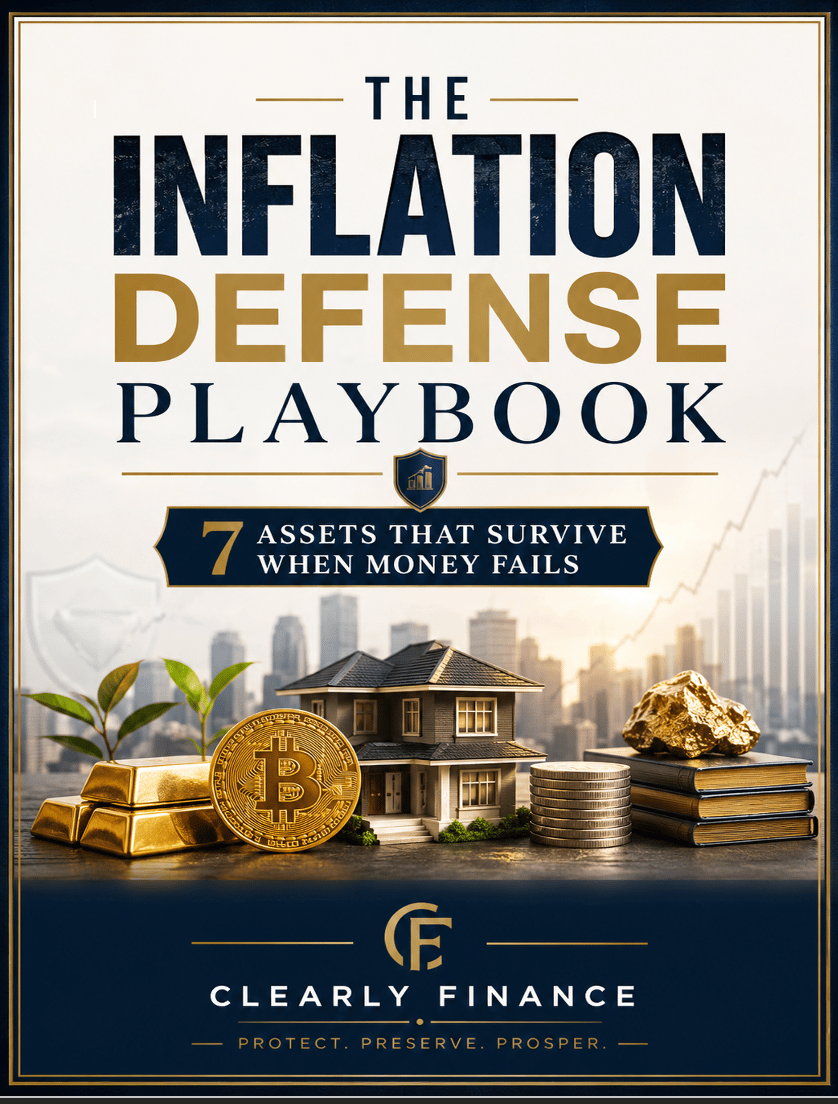
Seven Assets That Survive When Money Fails
The complete, plain-English playbook for defending your savings from inflation. Built for people with $50K to $2M+ who want a defense, not a gamble.
Seven Assets That Survive When Money Fails
The complete, plain-English playbook for defending your savings from inflation. Built for people with $50K to $2M+ who want a defense, not a gamble.
- 7 assets that protect your money against lost purchasing power
- In depth analysis on why each belongs in your portfolio
- Suggested allocations
- Estimated returns
- BONUS: Free Allocation Simulator App - stress test your portfolio ($19 value)
Get the Inflation Defense Playbook Now!
- Don't let inflation destroy your hard-won capital
- Know what assets to hold and why
- Know the allocations that best protect your wealth
7 Day Money Back Guarantee
$97 $47 one-time payment, no subscription. BONUS: Free Allocation Simulator ($19 value)
Inflation isn't a forecast. It's arithmetic. The federal government owes more than $39 trillion it can't realistically pay back, and there are only two ways out: default, or inflate the debt away.
Inflation isn't a forecast. It's arithmetic. The federal government owes more than $39 trillion it can't realistically pay back, and there are only two ways out: default, or inflate the debt away.
No Fed in history has chosen default.
That choice has a cost, and you pay it. Quietly. In the purchasing power of every dollar you've saved.
The dollar has already lost 88% of its value since 1971. In May headline inflation re-accelerated to 4.2% before moderating to 3.5% in June.
But core inflation didn't budge. Inflation is settling in, and a savings account paying less than inflation is a slow, guaranteed loss.
No one has a crystal ball, but we may be entering a period of systemic higher inflation.
The experts on the financial news have a word for it. Ingrained.
Or "unanchored," if the economists are feeling fancy.
No Fed in history has chosen default.
That choice has a cost, and you pay it. Quietly. In the purchasing power of every dollar you've saved.
The dollar has already lost 88% of its value since 1971. In May headline inflation re-accelerated to 4.2% before moderating to 3.5% in June.
But core inflation didn't budge. Inflation is settling in, and a savings account paying less than inflation is a slow, guaranteed loss.
No one has a crystal ball, but we may be entering a period of systemic higher inflation.
The experts on the financial news have a word for it. Ingrained.
Or "unanchored," if the economists are feeling fancy.
Here's what it means in plain English. For a while, inflation is just a reaction. A supply chain snaps, oil spikes, prices jump. Annoying, but temporary. Everybody figures it'll pass.
Then something flips.
People stop treating high prices as a one-off and start treating them as the new normal.
Not a reaction anymore. An expectation.
And the second that expectation sets in, the whole psychology of the economy shifts underneath you.
Inflation stops being something that happens to the economy. It becomes something the economy does to itself.
I’m sure you've read about Apple raising prices. Fifteen to 25%.
Twenty-five percent.
The rationale? Higher memory and storage chip costs. Exacerbated by the AI infrastructure build out.
Apple’s price increases followed significant price increases by Microsoft, Dell, Lenovo, HP, Acer, and ASUS earlier this year.
Even though they all blamed memory and storage chips, Microsoft raised prices on their flagship Office software, too. By as much as 13%.
When inflation expectations take hold, companies feel much more comfortable raising prices.
I’m sure you've read about Apple raising prices. Fifteen to 25%.
Twenty-five percent.
The rationale? Higher memory and storage chip costs. Exacerbated by the AI infrastructure build out.
Apple’s price increases followed significant price increases by Microsoft, Dell, Lenovo, HP, Acer, and ASUS earlier this year.
Even though they all blamed memory and storage chips, Microsoft raised prices on their flagship Office software, too. By as much as 13%.
When inflation expectations take hold, companies feel much more comfortable raising prices.
When inflation becomes engrained, it typically plays out in three steps. And the irony? None of them need the original problem to still exist.
Step 1: Wages and prices start chasing each other
Normally you ask for a raise because you earned one. You closed the deal, you shipped the thing, you're worth more than you were last year.
Ingrained inflation breaks that.
Now you're not asking based on what you did. You're asking based on what you think next year costs. You expect 6% inflation, so you demand 7%. Just to stand still.
Your boss pays it. But to cover that bigger payroll, the company raises its prices. Which makes everything cost more next year. Which makes everybody ask for another raise. Which pushes prices up again.
Wash, rinse, repeat. Wages chase prices, prices chase wages, and nobody actually gets ahead.
Step 2: Cash becomes the thing you don't want to hold
When you stop trusting that a dollar buys next year what it buys today, sitting on cash starts to feel dumb. Holding money turns into a slow leak.
So you stop waiting. I would. You would. Anybody paying attention would.
That machine the business needs? They were going to buy it next year. Now they buy it today, because next year it's 10% more. That car you've been saving for? You buy it now, before six months from now makes it worse.
Everybody pulls their spending forward at the same time. All that demand lands at once, on top of supply that hasn't budged. Prices climb faster.
And the money moves quicker, too. Economists call that velocity. How fast a dollar changes hands. Fast money on a fire is just gasoline.
Step 3: The Fed has to break something on purpose
This is the part nobody wants to hear.
Once expectations are ingrained, the Fed can't fix it with a few gentle rate nudges. The polite tools quit working. The public has stopped believing inflation drifts back to target on its own.
And the moment they stop believing it, what the Fed says doesn’t hold nearly as much weight.
So the Fed is left with one option. An ugly one.
It has to scare everyone straight. Raise rates so high, so far past comfortable, that it crushes demand on purpose.
Tanks the markets. Kills hiring. Drives unemployment up.
Deliberately.
The point isn't to slow the economy. The point is to reset what people expect.
We've seen this movie. Late '70s, early '80s. Paul Volcker took the federal funds rate past 20%.
Past 20%.
Two recessions back-to-back. Not because he wanted them. Because it was the only way he could find to kill ingrained expectations.
Now, nobody thinks we’re headed for that kind of cataclysmic outcome.
But higher prices for longer? We may be just seeing the beginning of that.
The Good News...?
You don't need to predict the next crisis to be protected from it. You need a defense that works across all of them. A small number of assets, sized correctly, that have held their value through every inflationary era on record. That's the entire Playbook.
The 3 Biggest Mistakes Investors Make Trying to Protect Their Savings from Inflation
Mistake #1: Hoarding Cash In The Name Of Safety
The most common mistake is conflating a stable numerical balance with stable purchasing power. When inflation is high, sitting on large amounts of cash, even in a High-Yield Savings Account (HYSA), is a guaranteed way to lose wealth safely.
The Reality: If inflation is running at 4% and your high-yield account pays 4.25%, your nominal return looks good, but your real (inflation-adjusted) return is a measly 0.25% before taxes. Once taxes are deducted from that interest, your real return is net-negative.
The Verdict: HYSAs and short-term CDs are places to store liquidity (like emergency funds), not tools to fight inflation. Keeping long-term investment capital in cash out of fear of market volatility means choosing the certainty of inflation's slow bleed over the volatility of growth assets.
Mistake #2: Over-Allocating to Non-Yielding "Hedges" (Like Gold)
When headline inflation spikes, a knee-jerk reaction is to dump capital into traditional tangible assets like gold or precious metals. While gold can preserve purchasing power over multi-decade or century-long horizons, it carries a massive opportunity cost during shorter windows.
The Reality: Gold doesn't compound, generate earnings, or pay dividends. It sits there. During periods of normal or even slightly elevated inflation, equities (which represent real businesses that can raise prices to maintain margins) often outperform static commodities. But we are in unique times, and central bank's are accumulating gold in record numbers and the projections are for that to continue providing tangible support
The Verdict: Gold has its place, but flooding a portfolio with non-earning assets means missing out on the compounding power of companies that pass higher costs directly onto consumers. A small allocation for volatility insurance is justifiable. Treating it as a primary growth engine is a mistake.
Mistake #3: Misunderstanding the Interest Rate Risk of "Safe" Bonds
People looking for safety often flock to long-term government bonds or fixed-income products, assuming the guaranteed coupon yield will offset inflation. They forget that inflation and interest rates are tied at the hip.
The Reality: When inflation rises, central banks raise interest rates to cool the economy. When new interest rates rise, the value of existing bonds with lower fixed yields drops sharply on the secondary market. If you hold a 10- or 30-year bond and need to liquidate it during an inflationary spike, you will take a massive capital loss. Even Treasury Inflation-Protected Securities (TIPS) suffer price drops in the secondary market when real yields spike rapidly.
The Verdict: Long-duration fixed income gets absolutely crushed in an environment of rising inflation and rising rates. If you use bonds as an inflation buffer, you have to keep durations short or hold individual securities to maturity to avoid locking in capital losses.
Introducing The Inflation Defense Playbook
For investors with savings worth protecting.
Not traders chasing the next hot stock.
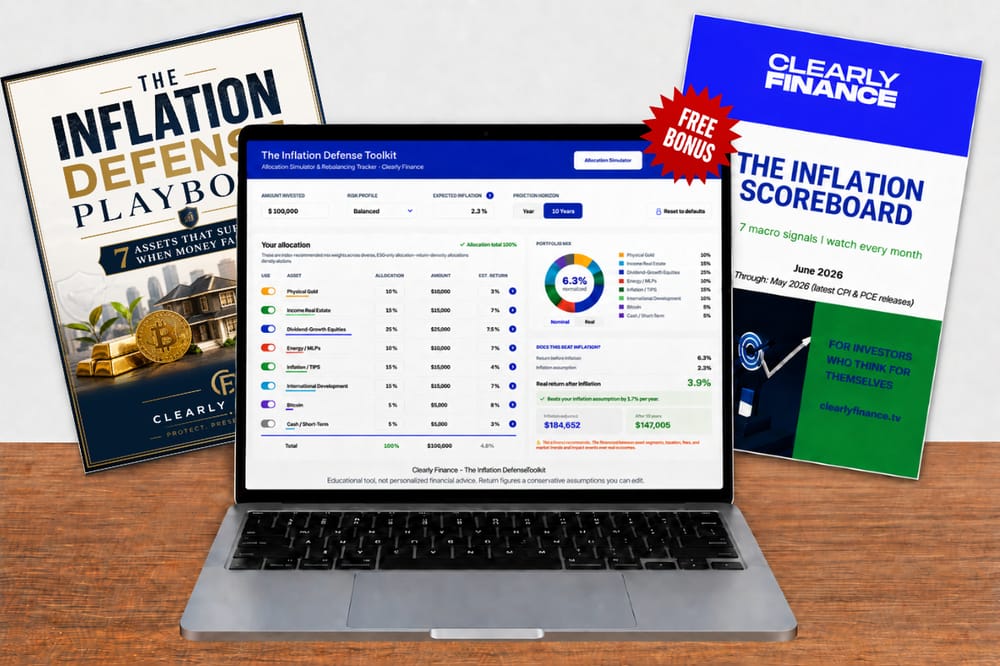
The Inflation Defense Playbook is a written, do-this-in-order framework for an investor who actually has something to protect. Someone with somewhere between $50,000 and a few million, and wants it to keep its purchasing power instead of quietly bleeding out. Not a trading system. Not a newsletter. A plan.
Seven assets. Each one defends your money through a different mechanism, which is the entire point.
For every asset: How to own it. How much to hold. Where to put it so the IRS takes the smallest possible bite. And the order to buy.
It comes in three versions.
- Conservative, for someone at or near retirement who can't afford a bad year.
- Balanced, for the mid-career investor with a decade or two of runway
- Aggressive, for the reader with time on their side
Same seven assets. Different proportions. Matched to how soon you'll need the money.
What it won't do. It won't make you rich. It won't name the next 10x stock or the right week to buy. Anything promising that is selling a fantasy, and the people who buy the fantasy get hurt worst when the cycle turns.
This is calmer than that. On purpose. No countdown timer. No claim the system collapses next month. The arithmetic of the debt makes the case on its own. It doesn't need the volume.
$97
Inflation is arithmetic. So is the defense.
Get the math, the seven assets, and the order to build them — before the dollar takes another bite.
What's Inside
- The 7-asset framework — with each assets correlation coefficinet calculated to the S&P so you can see just how diversified you can be.
- Exactly how to own each one — the vehicles, the tickers, the platforms, the common mistakes that quietly cost people money. The 7-asset framework — physical gold, income real estate, dividend-growth equities, energy infrastructure, I-Bonds & TIPS, international equities, and a disciplined Bitcoin allocation (0% is a valid choice).
- Three risk profiles — conservative, balanced, aggressive — with the exact percentages for each.
- A 12-month implementation plan — what to buy, and in what order, so you're not trying to do everything at once.
- The exclusive 12-name dividend watchlist — the pricing-power companies that can raise prices faster than inflation.
Your Free Bonus — The Allocation Simulator
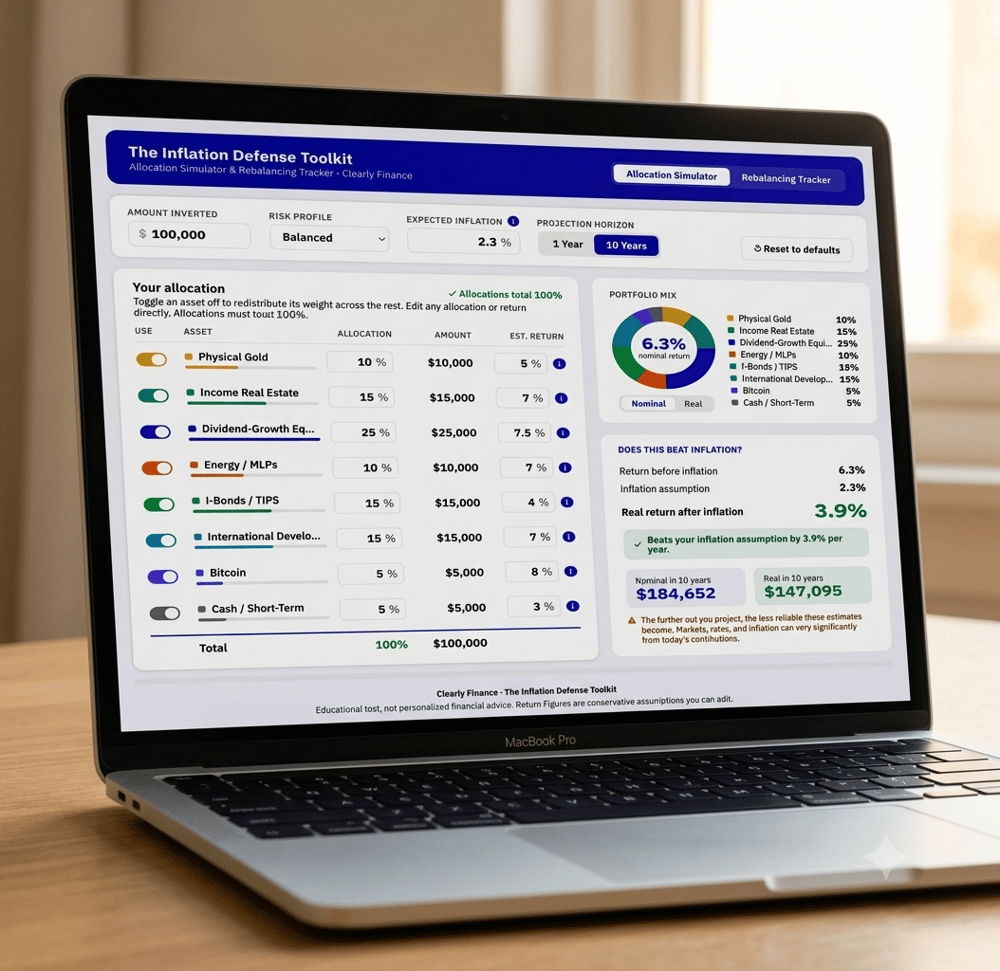
Included free (a $19 value): an interactive web app that does the math for you. Enter your intended investment. Decide what assets you want to hold and your risk profile, and the simulator shows the exact dollars to put in each asset.
It delivers 1 and 10 year nominal and real returns. It tells you how your mix holds up against expected inflation and your purchasing power after inflation.
Toggle any asset on or off and it redistributes instantly.
Once your assets grow, the Rebalancing Tracker tells you if you've drifted off your target allocation and if so by how much. With a click of a button, it shows you rebalanced allocations that put you back on track.
People charge subscriptions for tools like this. But it's yours free inside the Playbook.
Who this is for...
It's for you if you have savings you can't afford to watch erode, and you want a clear, calm framework you can actually act on.
It's NOT for you if you're looking for a hot stock tip, a get-rich-quick trade, or a reason to panic. This is wealth preservation and defense, not a lottery ticket.
The Inflation Defense Playbook — $97 $47, one time. Lifetime access to the 60+page PDF, the dividend watchlist, the 12-month plan. No subscription required. BONUS: Free Allocation Simulator ($19 value).
7 Day Money Back Guarantee
7-Day No Hassle, Money-Back Guarantee

Read it, use the Simulator, and put the framework to work. If within 7 days it hasn't changed how you think about protecting your money, email us and we'll refund every penny. The risk is ours, not yours.
What People Are Saying About Clearly Finance

"Great video. Optimistic and devoid of fear mongering. Thank you for the clear, simple reminder of these concepts."
@augenmaugen
"Far too views for such as great video on the world's most intricate scam planned yet."
@gurmeetsandhu7340
"Watched a lot of youtubers to get this figured out. Your info explains it best. Thank you. Got it now. Keep up the good work."
@casjpoelker
"Great video. Thank you."
@jimandjanealexandris7085
"It is criminal that this is not taught in schools."
@denniss3980
"Best video on YouTube."
@Ahmed-v7e3u
Frequently Asked Questions
"Is this individual investment advice?”
No, it's an educational framework. It tells you how the assets work and how to think about sizing them. What you do is your call.
“I'm not wealthy. Is this still useful?”
Yes. The framework scales to any amount, and the Simulator works whether you're protecting $20,000 or $2 million. Inflation is everyones problem, not just the ultra-rich
“Do I have to buy all seven assets?”
No. You don't have to buy any of them. And the Simulator lets you switch any asset off and automatically redistributes your allocation to the rest. Bitcoin at 0% is explicitly fine, for instance.
“What if it's not for me?”
The 7-day no hassle, money-back guarantee covers you completely.
"How can I reach you?”
The easiest way is to email us here. If you would like to send us snail mail, send it to Clearly Finance, 5900 Balcones Drive, Suite 24851, Austin, Texas 78731 USA.